How Does Apollo AI Work? Its Three Steps, Explained in Plain English
How does Apollo AI work? Its three steps, what the dashboards and confidence labels mean, what 'neural network' claims can and cannot do, and why draws stay random.
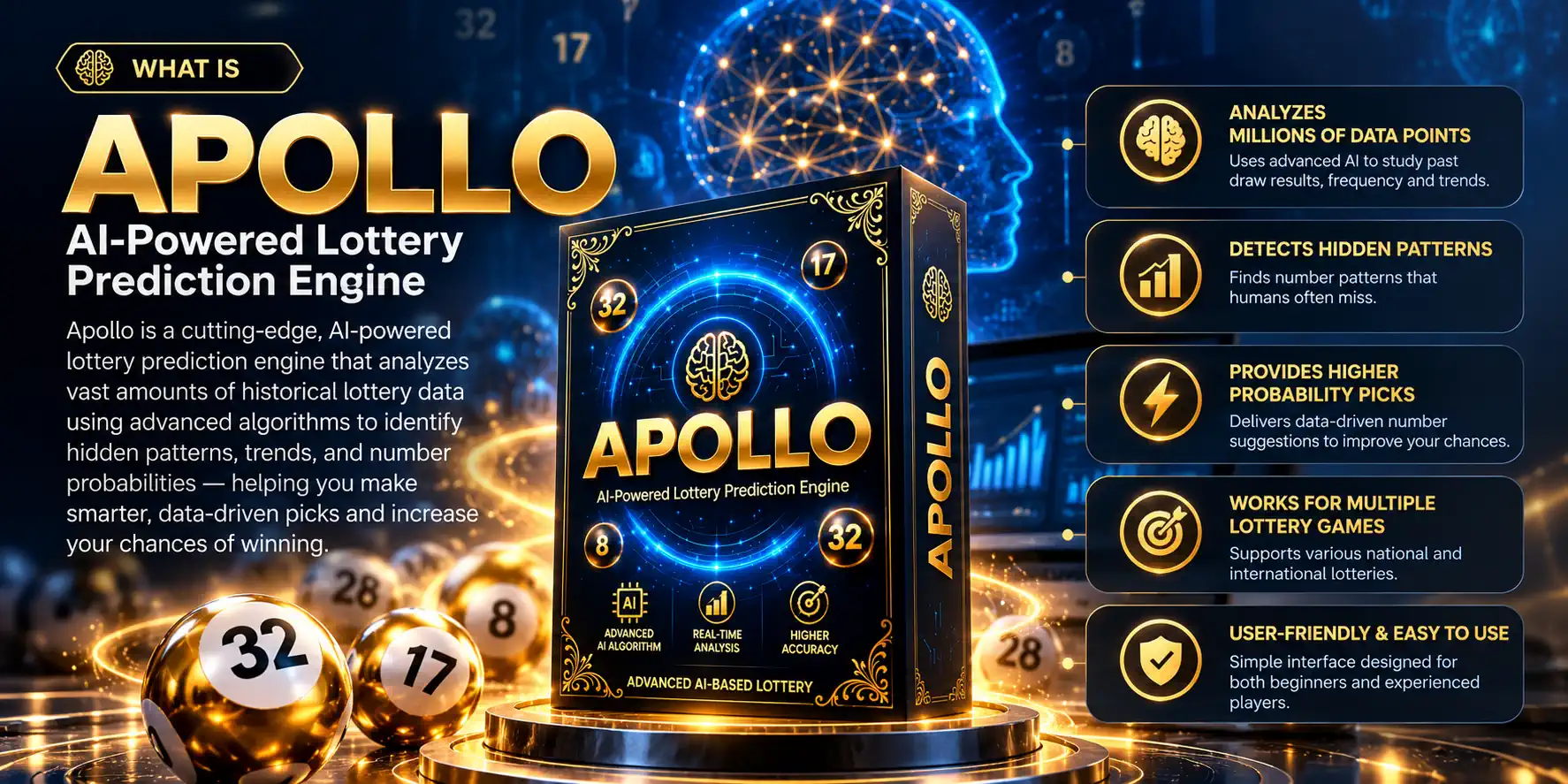
"How does Apollo AI work?" is the right question to ask before spending $147 on lottery software. This explainer walks through the three steps described on the official site, what each produces and how to interpret it honestly.
The three steps
Step 1: Initialize your preferences
You choose your lottery game and enter details such as your region and playing preferences. This tailors the dashboard to the draws you actually play.
Step 2: The processing engine
The software analyzes historical draw data. The official site describes this using terms like deep learning, neural networks and "quantum-inspired" processing. In practical terms, it computes statistics on past results, such as frequencies, gaps and co-occurrences, and uses them to build its outputs.
Step 3: Receive number sets
You get generated number sequences with confidence ratings and probability analysis.
What the outputs actually mean
Frequencies and patterns
These describe history: which numbers came up, how often, how recently. They are accurate summaries of the past.
Confidence ratings
These are the tool's own scores for the sets it generates. They do not mean a set is more likely to be drawn. In a fair lottery, every combination has exactly the same probability.
"Probability analysis"
The genuine probability of any specific combination is fixed by the game's design, for example 1 in 292,201,338 for a Powerball jackpot. No analysis can change that number.
Why history cannot predict the next draw
Lottery machines and random number generators are designed and audited so that each draw is independent. The balls have no memory. A number that appeared last week is exactly as likely as any other to appear this week. Believing "overdue" numbers are due is called the gambler's fallacy.
So what is the "AI" for?
Machine-learning methods are excellent at finding patterns in data that has real structure, such as language, images or weather. A fair lottery is engineered to have no exploitable structure. Any patterns an algorithm "finds" in past draws are artifacts of chance. That's why we describe Apollo AI as a sophisticated way to organize and explore data, not as a predictor.
How to use it well
- Set a fixed entertainment budget.
- Log in and choose your game.
- Explore the history views for a few minutes.
- Generate and choose a set.
- Play within your budget, or simply enjoy the exploration.
The full workflow is in how to use Apollo AI.
A short note on "confidence"
Software often attaches confidence scores to outputs. In weather forecasting or medical imaging, those scores are calibrated against real outcomes and mean something measurable. In a fair lottery, there is nothing to calibrate against: every combination is equally likely, so no set can genuinely be "more confident" than another. When you see a confidence rating in Apollo AI, read it as a way the tool ranks its own outputs, a helpful organizing device rather than a statement about the future.
How lotteries protect randomness
Official lotteries use certified drawing machines or audited random number generators, independent observers and regular testing precisely so that no pattern can be exploited. That is good news for fairness, and it is why every player, with or without software, has the same chance on every ticket.
Questions people often ask
Does Apollo AI learn from each draw?
The official site says it continuously learns and evolves. Learning from random data cannot create an edge, but updates may improve the interface and analysis.
Is it different from free frequency charts?
It combines history, patterns and generation in one portal with lifetime updates. The underlying odds are identical.
Next steps
See what the software genuinely offers in Apollo AI benefits, and understand the math in lottery odds explained. For the full overview, visit the official Apollo AI page or our features guide. If it sounds enjoyable, view the Apollo AI offer.
Apollo AI · $147 one-time
14-day money-back guarantee on the lifetime license.